
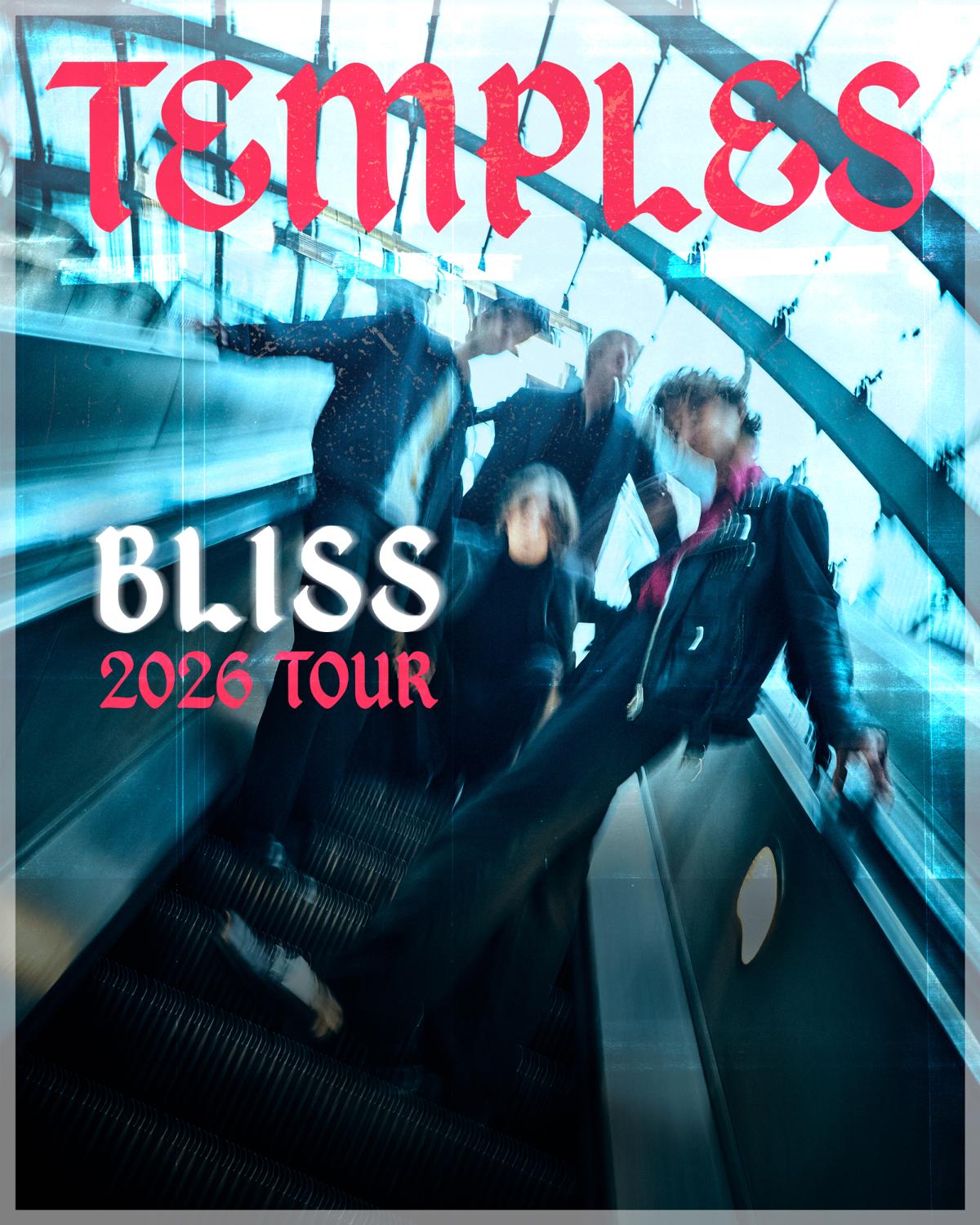
Temples Properties: Website: https://www.templestheband.com/ Facebook: https://www.facebook.com/templesofficial/ Instagram: https://www.instagram.com/templesofficial/ Twitter: https://twitter.com/templesofficial TikTok: https://www.tiktok.com/@templesofficial Youtube: https://www.youtube.com/channel/UCdorDsEgYHYAFhWC2a2l8YA Spotify: https://open.spotify.com/artist/4ogwGU9VPWrnVBs1GEwZVV Temples’ name has become synonymous with a band with an adventurous spirit; a group constantly coursing with ideas and invention. On their fifth album, ‘Bliss’, they prove that to be the case once again, shaking up the general perception of the Kettering-formed four-piece with a record that flies in new electronic directions, while staying true to their core DNA. The euphoric and melancholic melodies of late ‘90s dance music, and the golden era of the Ibiza scene, combine with psych-tinged riffs and loops to make something thrillingly fresh.As with any adventure, though, getting to this triumphant record wasn’t without its challenges. In 2023, the band -James Bagshaw (vocals/guitar), Thomas Walmsley (bass), Adam Smith (keyboards/guitar) and Rens Ottink (drums) -released their fourth album, ‘Exotico’. Instead of making a splash, its release felt more like an isolated drop. The reaction to it was passive, and some of the fans they met on the road were unaware it even existed. In the aftermath, an article asking “what happened to Temples” suggested Bagshaw had swapped band life for academia. “For the record, I do not work at Leeds University,” he laughs now.That response had nothing to do with the quality of the music or a lack of interest from their audience, but a disconnect in the system around the band. “That was the really disheartening thing,” says Bagshaw. “We knew that our fans were out there. We knew from going on tour that the fanbase was strong and still dedicated. Instead, it felt like there was this complacency from all areas outside of what we were doing.”Understandably dejected, when touring around ‘Exotico’ ended, the band hit a necessary standstill. They were keen to break free from the typical cycle of music-making where “your last record always informs what you do next”, but had to rebuild and reconnect with their original creative purpose that started this journey nearly a decade-and-a-half ago. “A lot of people have preconceptions of what you’re known for, or your sound,” reasons Walmsley. “There’s so much more to us as a band and as a group of people, and I feel like that’s found its way into the band as well. We’re completely reconnecting with why we started and who we’re making the music for -which is ourselves.”Eventually, Temples built a new team around them and signed a deal with V2 Records, but it was the creative relationship between the four band members that was key to their rejuvenation. After initially sending song ideas to each other remotely, it was when they got back in aroom together and began working on things in person that their “shared vision” and “just how fun” making this music was together became quickly apparent.Where on ‘Exotico’, the band worked with guest producer Sean Ono Lennon, this time it felt like ‘Bliss’ could only be produced by Temples themselves. “It was probably the most empowering thing we could do, because it didn’t rely on anybody else’s flair or creativity or patience,” Bagshaw explains. “That was very freeing. It felt like you could just improvise.”Improvise, they did. ‘Bliss’ finds the band experimenting with samplers –not to rework parts of other artists’ songs, but to do so with their own. Sometimes, they’d sample an element of the song they were working on at the time. “We’d get to this point in a song where something wasn’t fully realised, and we would then create samples of that song, then manipulate that to basically make a new sound,” says Bagshaw. The samples became a shared network across the album, a palette of sounds where each could be lifted from one song to another, reversed, reworked and reimagined. “Picasso had the blue period where he’d use those pigments and particular colours; we were building up audio Pantones. It feels a bit more like a collage and almost like remixing, but not in a traditional remix sense.”Sonically, the album sees Temples rework elements of dance music in their image. Lead single ‘Jet Stream Heart’, a song about being seduced by music, mimics the feeling of dancing right in front of the speakers in a club. “We all know that feeling of walking past somewhere where there’s loud music playing, and it’s that kind of allure -there’s something about hypnotic beats that just pulls you into the jet stream,” Bagshaw says. “Ironically, if this song was playing ina club and I was walking past, I’d be like, ‘What the fuck is that? I’m gonna go and check it out.'”The dazzling dart of ‘Vendetta’ perfectly marries scuzzy riffs with lasering synths and a bubbling dance melody. Originally, the two halves were intendedto be two separate songs, but it was only when the band put them together that they worked. “Suddenly, you had this almost Justice, Daft Punk-sounding sample that then goes into something that could be a modern take on dance music, like a David Guetta or Avicii song,” notes Bagshaw. “It should be a shock to the senses; it should make you want to move. It should feel resistant and like it’s pulling you in loads of different ways.”Similarly, ‘Blue Flame’ took shape from a chorus Smith had in his pocket forsome years. Slower, steadier and packed with that gently fizzing chorus, it tackles disconnection at its core, its icier sound reflecting a distance between both humanity and nature, and the growing divide between each other. ‘Revelations’ nods to the Gregorian chant that was commonly deployed in late ‘90s and early ‘00s European dance music with its own take, fittingly opening a track that has a spiritual bent. “The verses are quite angry, but more matter-of-fact, with a situation you’re in or the way things are,” Walmsley explains. “The chorus is the revelation moment where you’re realising that state is temporary and what’s permanent is that things change.”The crunching stomp of ‘Megalith’, too, deals with frustrations. “It’s about finding your inner stillness, but then having found that stillness, maybe it’s not so pleasant,” says Smith. “You can sometimes feel helpless and stuck when the world is moving around you, and you feel like a standing stone, like a megalith, and there’s nothing you can do about it. So it’s about both surrendering to the fact that you have no control over what happens, but also the fear that comes along with that.”Although too young to have been involved in the rave culture of the late ‘90s themselves, it’s something they grew up aware of, hearing the songs through older siblings’ bedroom doors. ‘Bliss’ connects to those memories and uses them to push forward, create something new. “There’s just something about that music where, albeit not very complex, it brings up complex emotions,” Bagshaw says. “It’s bittersweet -a melancholic euphoria.” Influences came from a vast spectrum of electronic music -Faithless, Underworld, Prodigy, Air, Röyksopp, Moby, Massive Attack, Orbital, Portishead, and more. “They all have something in common, and you can’t really define exactly what it is, but it’s a feeling and a mood -and we’ve wholeheartedly recreated that across this record.”To some, Temples turning to this era and genre for inspiration might seem out of the blue, a left-field choice, but to the band, it’s natural. The lineage and connection between psych and dance music is strong, both sharing a tendency for loops and trance-like states. “We’ve always had space in our songs, there’s repetition and some improvisation,” says Smith. “We’ve done the same here, but with a different sonic palette.”‘Bliss’, for the four members, represents not just a feeling in the music, but a synergy between the band and shared creative freedom. “If any record before was refining what we’ve done, it feels like ‘Bliss’ is about permission to let go and be more physical with our music and let everything breathe and build more,” says Walmsley.”We’re at a place where we’re just more accepting,” adds Bagshaw. “I think a lot of artists will agree that there are periods in your career where you don’t worry about your fans liking things. We don’t want them to hate it, but we’ve just done exactly what we want to do in a purely selfish way, and that becomes not selfish when people connect with it. You get that sense of creative bliss if you just do what you want as a group.Obviously, it references the past, but this is a forward-looking record that genuinely doesn’t sound like anyone else. People should throw out whatever they thought we were -this is what weare.”
